How to Coordinate Facials With Your At-Home Actives
Brenda Cammo Team

A professional facial and an active at-home skincare routine can work well together, but timing and communication matter. If you use retinol, exfoliating acids, benzoyl peroxide, vitamin C or prescription creams, your therapist needs to know before your appointment. This is not about giving up the products you value. It is about helping your skin avoid an unnecessary pile-up of stimulation in one week, or even on one day.
At Becammo, a facial begins with a conversation about your skin, your goals and the products you already use. That makes it easier to choose a suitable approach, whether you are booking a Brazilian Deep Cleansing facial, considering dermaplaning, or simply want a professional reset for skin that feels dull, congested or unsettled.
The key principle is simple: your home routine and your facial should complement each other. They should not compete for your skin’s tolerance.
Why your at-home actives matter before a facial
“Actives” is a useful everyday term for ingredients chosen to create a noticeable change in the skin. They may be part of a carefully built routine, but they can also make skin more reactive when several are layered too often or paired with additional exfoliation.
Common examples include retinoids, such as retinol and prescription retinoid creams, exfoliating acids including glycolic, lactic and salicylic acid, benzoyl peroxide, and stronger brightening or resurfacing products. These ingredients are not automatically a problem. The important question is how your skin is responding to them right now.
The American Academy of Dermatology’s guidance on exfoliating at home notes that retinol, prescription retinoid creams and benzoyl peroxide can increase sensitivity, and that adding exfoliation can worsen dryness or irritation for some people. This is why a professional facial should never be planned in isolation from the routine you use in front of your bathroom mirror.
A balanced plan protects comfort and helps you make clearer decisions. If your skin is already dry, stinging, peeling, inflamed or unusually red, adding another active product or intensive exfoliating step may not be the most helpful next move. A calming, simplified routine and professional advice may be more appropriate.
Start with an honest product list
Before booking, make a quick note of everything you apply to your face regularly. You do not need to memorise every ingredient, but photos of product labels can be very useful. Include products you may not think of as active skincare, such as medicated spot treatments, exfoliating cleansers, treatment pads, masks and overnight products.

What to tell your therapist
- The names or photos of your regular cleanser, serums, moisturiser and SPF.
- Whether you use retinol, retinal, tretinoin, adapalene or another retinoid.
- Whether you use AHAs, BHAs, PHAs, peeling pads, exfoliating scrubs or enzyme products.
- Whether you use benzoyl peroxide, sulphur or acne medication.
- Any prescription skincare or oral medication that affects your skin.
- Recent irritation, flaking, breakouts, sunburn, waxing, shaving or changes in your routine.
- Your main goal for the facial, such as hydration, a fresher feel, congestion care or preparing for an occasion.
This information allows the therapist to tailor the appointment responsibly. It may lead to a different choice of products, a gentler treatment plan, or a recommendation to postpone a particular step until your skin feels more settled. A professional adjustment is not a disappointing outcome. It is good skin judgement.
Think of your routine as a weekly picture, not one product at a time
One active product used carefully may suit your skin very well. Difficulties often arise when several exfoliating or potentially drying products appear across the same routine: an acid cleanser in the morning, a brightening serum, retinol at night, a scrub at the weekend and an active mask before a facial.
Each product can seem reasonable on its own. Together, they may leave skin feeling tight, shiny in an uncomfortable way, rough, tender or easily flushed. The American Academy of Dermatology also advises avoiding masks that duplicate active ingredients already used elsewhere in a routine, as this can contribute to dryness and irritation. You can read its practical advice in this guide to facial masks and skincare routines.
For facial planning, this means looking beyond the night before. Consider the previous few days, the current condition of your skin and what you hope to use afterwards. Your therapist can then help avoid stacking too many intensive steps close together.
How to plan before your facial appointment
There is no single timetable that suits every active ingredient, skin type and facial. The right spacing depends on the strength and frequency of your products, the condition of your skin and the treatment being considered. Prescription products require particular care, so follow the directions from your prescriber and ask them for advice if you are unsure about pausing or changing use.
Rather than following a generic social media schedule, use these practical steps.
- Book with your current skin in mind. If you have only just introduced a new active, avoid assuming your skin will react predictably by your appointment date. Give yourself room to adjust if sensitivity appears.
- Share your routine before the service starts. Mention every active product, including occasional masks and spot treatments. A product used only once a week can still matter.
- Do not add a new product just before a facial. New formulas can trigger irritation or an unexpected reaction. Keep the days leading up to the appointment uncomplicated where possible.
- Choose gentle basics when skin feels stressed. A mild cleanser, moisturiser and daily broad-spectrum SPF can make a useful temporary foundation while you seek tailored advice.
- Let the facial plan stay flexible. The best choice on the day may be different from the treatment you first expected. Your skin’s condition should guide the session.
Patch testing new skincare can also be a sensible precaution. The American Academy of Dermatology’s patch-testing advice explains a cautious way to test a product before introducing it more broadly. If you develop a significant reaction, persistent rash, swelling or discomfort, seek advice from an appropriate healthcare professional rather than trying to solve it by adding more products.
Matching common actives to professional facial planning
Retinol and other retinoids
Retinoids are widely used in home routines, yet they can cause dryness and irritation, especially during the adjustment period. Tell your therapist exactly which retinoid you use and whether it is a cosmetic retinol product or a prescription medicine. If your skin is peeling, sore or highly reactive, that information may change the service plan.
The American Academy of Dermatology’s overview of retinoids and retinol highlights that irritation can be a concern and advises daytime sun protection. It also notes that people with pronounced redness or inflammation should seek individual professional guidance. Do not restart or alter prescription treatment solely because of a facial booking without checking with the clinician who prescribed it.
Exfoliating acids
AHAs, such as glycolic and lactic acid, and BHAs, such as salicylic acid, can appear in cleansers, toners, serums and masks. They are easy to duplicate without realising it. If you use several products containing acids, tell your therapist about the full routine, not only your main serum.
For someone booking a facial that may include exfoliating elements, that conversation helps avoid treating exfoliation as an automatic extra. More is not necessarily better. Skin that feels comfortable and supported is often a better starting point than skin pushed to its limit.
Benzoyl peroxide and targeted blemish products
Benzoyl peroxide and targeted spot treatments may be part of an acne-focused routine. They can be drying or irritating for some people, particularly alongside other actives. Mention whether you apply them across the face or only in certain areas. This can help the therapist work with the skin that is actually in front of them, including areas that may need a gentler approach.
Vitamin C and brightening routines
Vitamin C products vary greatly in formula and strength. Many people use them comfortably, while others notice tingling or sensitivity, especially when combining them with multiple acids or retinoids. There is no need to label an ingredient as good or bad. The useful question is whether your individual skin is settled, and whether the full routine is manageable around your planned facial.
Different facials need different conversations
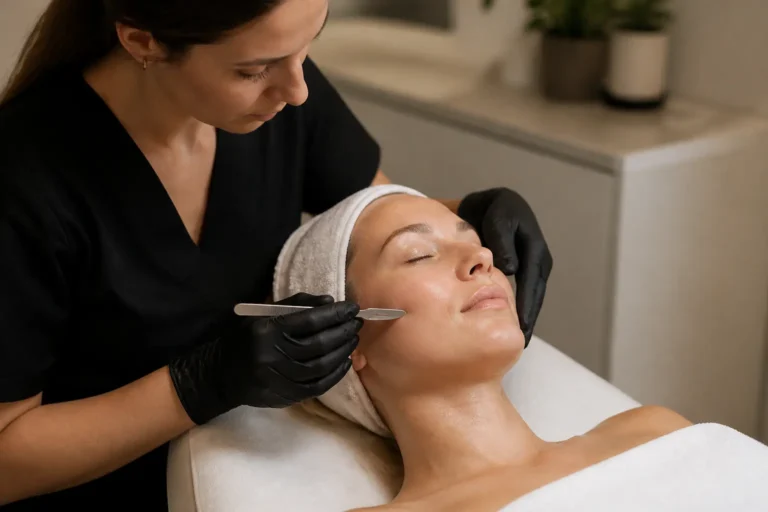
Not every facial places the same demands on the skin. A Brazilian Deep Cleansing facial, for example, is often chosen by people who want professional attention for congested skin and visible build-up. Dermaplaning is a different service, involving surface-level hair and skin-cell removal, so the therapist needs to know about recent exfoliation, sensitivity and home products before deciding whether it is suitable that day.
A facial that focuses on comfort, hydration and a refreshed appearance may call for a different home-care conversation from a session with stronger resurfacing elements. This is why booking descriptions are only a starting point. The in-studio consultation is where your routine, skin condition and goals come together.
If you are unsure which option fits your current routine, it is better to ask before booking than to guess. This is especially true if you are using a prescription product, have a diagnosed skin condition, are pregnant or breastfeeding, or are experiencing persistent irritation. A beauty therapist can discuss the service and its immediate skincare considerations, while a dermatologist or prescribing clinician is the right person for medical advice and medication changes.
What to do after your facial
After a professional facial, resist the urge to make up for skipped products by applying every active that evening. Your therapist can give service-specific aftercare based on what was done during the appointment and how your skin looked on the day.
In general, keep the focus on gentle cleansing, moisturising and sun protection while your skin settles. Avoid experimenting with unfamiliar products immediately afterwards. If you usually use actives, reintroduce them according to the advice you receive and your own tolerance, rather than assuming your usual frequency is instantly right after every facial.
Pay attention to what your skin tells you. Tightness, burning, prolonged redness and flaking are not signs that a routine is working harder. They are useful signals to simplify, pause non-essential actives and ask for suitable advice. The aim is steady, comfortable care, not an aggressive cycle of stripping and correcting.
A simple example of coordinated care
Imagine you use a retinol serum on some evenings, a salicylic acid cleanser a few times a week and an occasional exfoliating mask. You would tell your therapist about all three before booking a facial. If your skin feels smooth and comfortable, the therapist can discuss a plan that respects the work your home routine is already doing. If it feels dry or stingy after a recent increase in retinol, a gentler appointment or a later date may make more sense.
Another example is someone with oily, congested skin who uses several products because they want quick clarity. A professional facial can be a helpful moment to review whether the routine has become too complicated. The goal is not to remove every active product. It is to avoid unnecessary overlap and create a rhythm your skin can tolerate.
Conclusion
Your home routine and professional facials do not need to be separate worlds. When your therapist knows what is already in your skincare cupboard, they can make more informed choices for your appointment and help you avoid avoidable irritation.
Bring your product list, be honest about how your skin has been feeling and stay open to a personalised plan on the day. If you are in Malta and would like help choosing a facial around your current routine, book with Becammo in Sliema or Swieqi and share your active products when you arrive.
Frequently asked questions
Should I stop using retinol before a facial?
It depends on the retinol product, how often you use it, your skin’s current condition and the facial being considered. Tell your therapist in advance, and follow your prescriber’s advice for any prescription retinoid.
Can I have a facial if I use salicylic acid?
Often, a facial can still be planned, but your therapist needs to know the product type, frequency and how your skin is tolerating it. This helps prevent unnecessary overlap with exfoliating steps in the appointment.
What skincare should I bring to my facial appointment?
A written list or clear photos of the labels of your cleanser, serums, treatments and SPF are usually enough. Include occasional masks, spot treatments and prescription skincare.
Can I use my normal active serum on the night after a facial?
Ask your therapist for advice based on the facial you received. A simple, gentle routine may be more suitable immediately afterwards, particularly if your skin feels sensitive.
What if my skin is peeling or stinging before my booking?
Contact the studio before your appointment and explain what is happening. The team can discuss whether a gentler option or rescheduling is more appropriate. For severe, persistent or worsening symptoms, seek advice from a qualified healthcare professional.