Full-Face Threading or Dermaplaning: Key Differences
Brenda Cammo Team
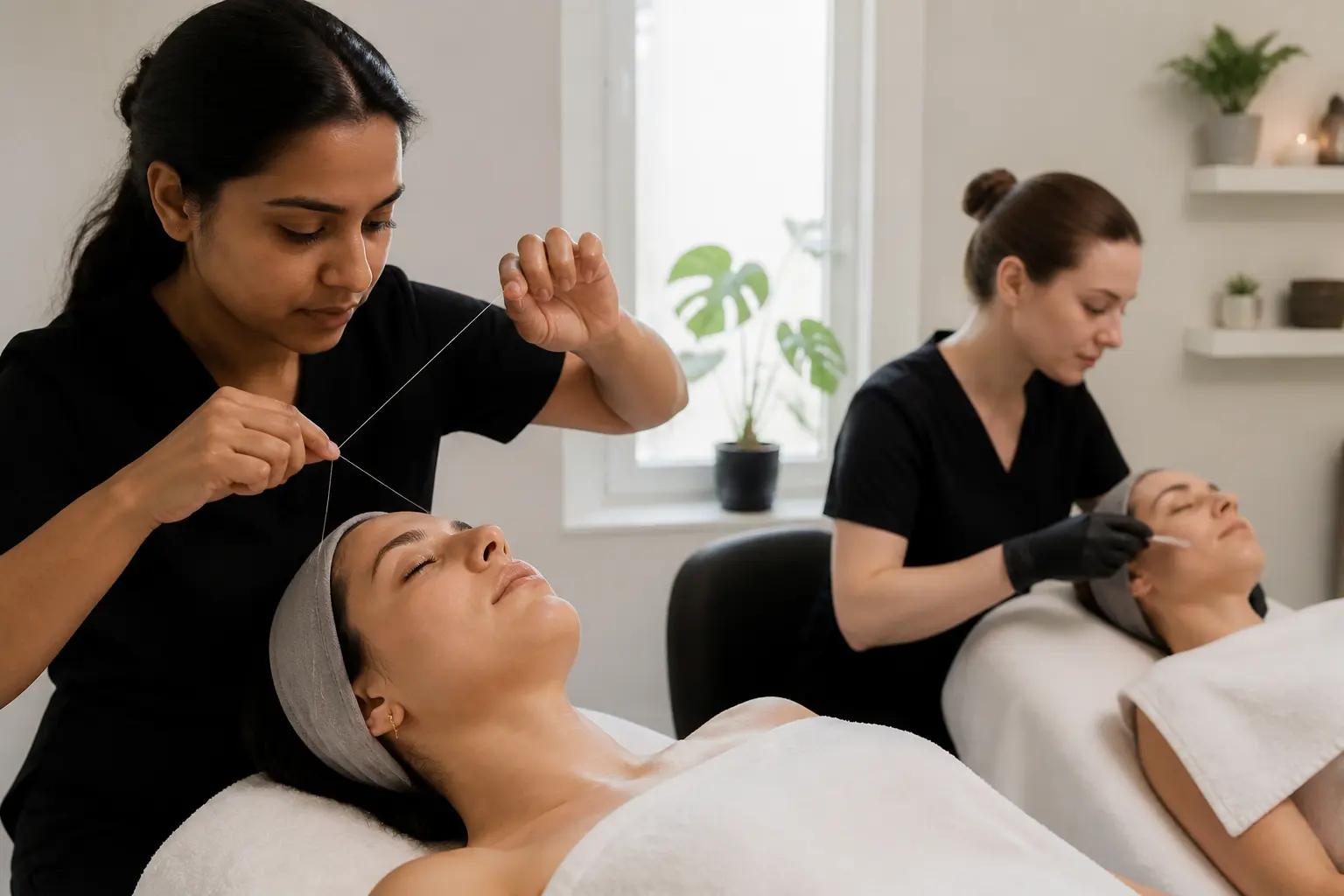
Full-face threading and dermaplaning can both leave the face looking smoother, but they do not do the same job. The simplest difference is this: full-face threading is primarily a hair-removal service, while dermaplaning combines the removal of fine facial hair with superficial exfoliation.
That distinction matters when you are deciding what you want from an appointment. Perhaps you notice defined hairs around the brows, upper lip, chin or other facial areas and would like them removed with precision. Or perhaps your main concern is a layer of soft peach fuzz, a dull-looking surface and the way make-up sits on your skin. These goals can overlap, but they lead to different conversations with your beauty professional.
This guide explains how full-face threading and dermaplaning differ in their hair-removal focus, what each appointment is designed to prioritise, and how to choose without assuming that one method is automatically better for every face or routine.
The quick comparison: hair removal versus hair removal plus exfoliation
| Question | Full-face threading | Dermaplaning |
|---|---|---|
| Primary focus | Removing selected facial hairs with thread | Removing fine surface hair while exfoliating the skin’s outermost surface |
| How hair is removed | Hair is caught by twisted thread and removed from the root | Fine hair is cut at skin level with a professional blade |
| Hair often discussed | More visible or individual hairs, depending on the area | Soft, fine vellus hair, often called peach fuzz |
| Skin focus | Shape, tidiness and hair-free facial areas | Surface smoothness and gentle exfoliation as well as fuzz removal |
| Result to plan for | A cleaner, more defined hair-removal result | A smoother-feeling facial surface and a refined make-up canvas |
Neither service changes the way hair grows at its source. Threading removes hair from the root, whereas dermaplaning cuts very fine hair at the surface. The feeling of regrowth, your skin response and the timing that suits you can therefore be different.
What full-face threading is designed to do
Threading is an established method of facial hair removal that uses a twisted thread to catch and lift hairs. At Becammo, disposable thread is used for each client, with cotton as the usual option and polyester available for clients with a cotton allergy. The approach is especially valued for the control it allows around small facial areas.
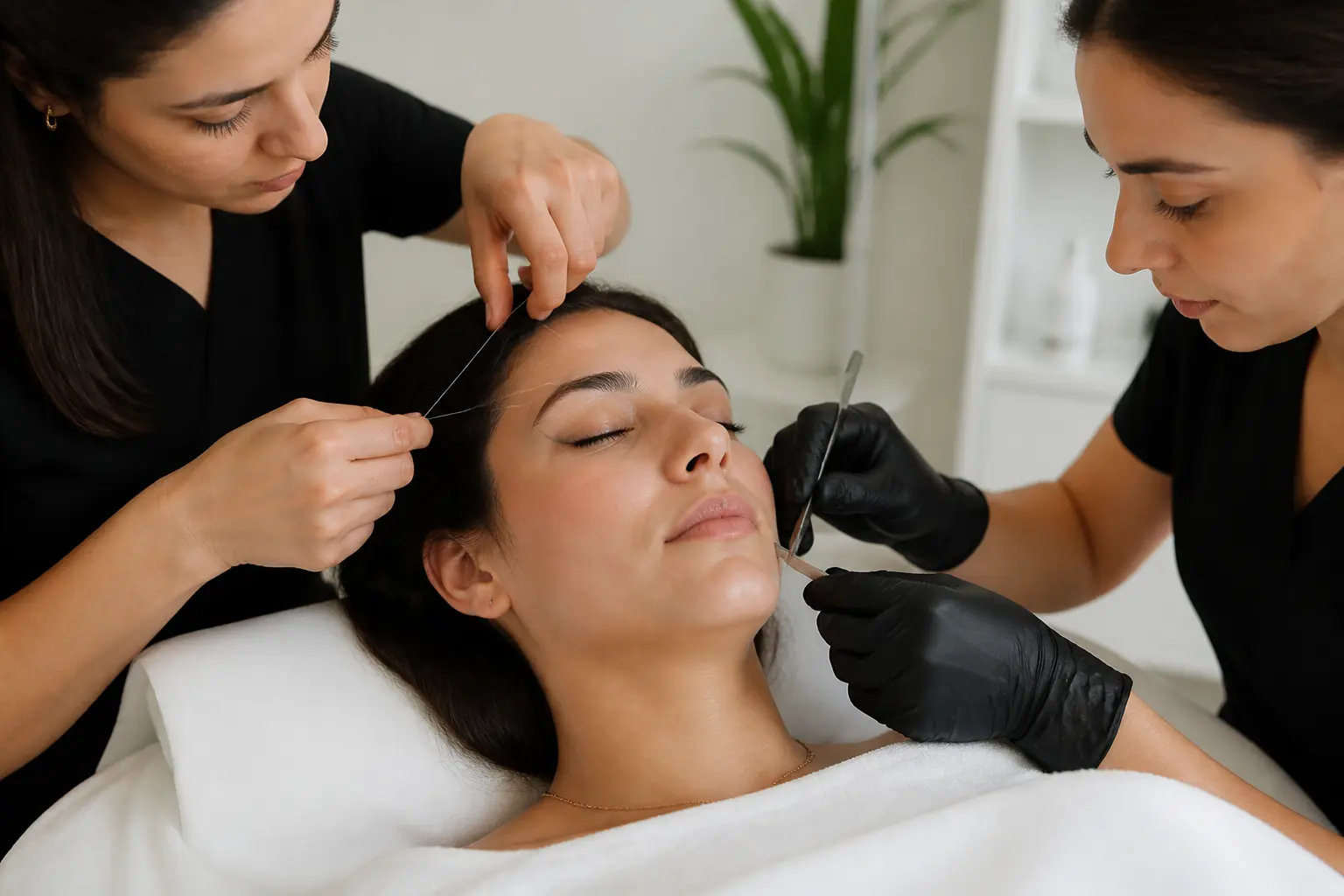
When someone books full-face threading, the central question is usually: which hairs would I like removed or refined? It may be about creating a tidier appearance around the brows, clearing the upper lip, refining the chin area or removing facial hair across the areas agreed in the consultation. The service is not intended to exfoliate the whole facial surface in the same way as dermaplaning.
Why precision is the main advantage
Because the thread can target hairs in a line or in small sections, full-face threading is useful when the visibility and placement of the hair are the main concern. This is particularly relevant around the eyebrow area, where shape, symmetry and the amount of fullness to retain should be discussed rather than assumed.
That personalised approach matters for every brow type. A defined brow result does not need to mean a thin brow, an identical brow on each side or a shape that follows one beauty trend. The aim is to work with the person’s natural growth, facial features and preferences.
What threading can feel like
As hair is removed from the root, threading can involve a brief pulling or tugging sensation. Sensitivity varies between people and can also vary by area of the face. Mild temporary redness can happen after hair removal, so it is sensible to plan around important events rather than leaving a first appointment until the last possible minute.
Good hygiene and professional technique are important. A consultation should also give you the opportunity to mention sensitivity, active irritation, recent facial treatments or any product that has changed how reactive your skin feels.
What dermaplaning is designed to do
Dermaplaning uses a professional blade held at a controlled angle to remove very fine surface hair and dead skin cells from the outer layer of the skin. It is often chosen by people whose main goal is a smoother-feeling complexion, especially when they feel that peach fuzz or a build-up of surface cells is affecting the look of their skin or make-up finish.
The hair involved is generally vellus hair: the soft, fine hair that naturally appears across much of the face. Dermaplaning can remove this fuzz during the session, but its purpose is broader than hair removal alone because the blade also provides superficial exfoliation. The Cleveland Clinic’s overview of dermaplaning similarly describes the procedure as removing peach fuzz while exfoliating the skin’s surface.
Why the skin-surface element changes the choice
If you are mainly thinking, “I want my complexion to feel smoother and my base make-up to apply more evenly,” dermaplaning may be the more relevant conversation. The surface exfoliation is a meaningful part of the appointment; it is not merely an added benefit to facial shaving.
By contrast, if your goal is to remove more individually noticeable hairs or create clean definition in particular areas, full-face threading may better match that goal. Dermaplaning is not a brow-shaping service and should not be treated as a substitute for a considered eyebrow design appointment.
A note on regrowth myths
It is common to worry that shaving fine facial hair will make it grow back darker, thicker or faster. Cutting hair at the surface does not alter the follicle or change the biological pattern of growth. As the blunt cut end grows out, it may temporarily feel different to the touch, but that does not mean the hair itself has become thicker.
Hair type and visibility: the most useful way to compare
The phrase “facial hair” can describe many different things. It is more helpful to consider the type of hair and your desired finish than to choose only by the name of the treatment.
When full-face threading may be the clearer fit
- You are focused on removing hair from specific facial areas rather than exfoliating the entire skin surface.
- You want the control of a method that removes hair from the root.
- You would like brow shaping or tidy-up work to form part of the discussion.
- You notice hairs that feel more visible to you than soft, even peach fuzz.
- Your priority is a clean, refined hair-removal result around agreed facial zones.
When dermaplaning may be the clearer fit
- Your main concern is fine vellus hair across the face.
- You want a facial service with a strong focus on surface smoothness.
- You are preparing for make-up and would like to discuss a smoother base.
- Your complexion feels dull at the surface, rather than congested or in need of targeted hair removal.
- You want to combine fine-fuzz removal with a gentle exfoliation-focused appointment.
There is no need to describe your hair with technical terms when booking. Simply explain what you see, what bothers you, whether your priority is hair removal or skin texture, and whether you have a date or occasion in mind. Those details help guide the right recommendation.
Do the two procedures remove hair in the same way?
No. This is the most important practical difference.
Threading removes the hair from the root. The twisted thread catches hairs and lifts them out. Because of that, people often plan threading around their individual hair-growth pattern and how soon they begin to see new hairs appearing.
Dermaplaning cuts fine hair at the skin’s surface. The same pass also lifts away superficial dead skin cells. It is a different mechanism, so it should not be judged by whether it behaves like threading. It is better judged by whether its skin-smoothing and peach-fuzz-removal focus meets your needs.
Both methods are temporary. How long you feel happy with the finish depends on your natural hair growth, the areas treated, your skin routine and your own preference for when you like to book again.
Aftercare: similar care, different reasons
Both appointments involve the face, so a calm aftercare plan is sensible. However, the reason for that care differs slightly. After threading, skin may feel temporarily sensitive because hairs have been removed from the root. After dermaplaning, the skin surface has also been exfoliated, so a gentle approach is particularly important.
After full-face threading
- Avoid rubbing or touching the treated areas unnecessarily.
- Keep your routine simple if your face looks or feels temporarily reactive.
- Use clean hands and clean make-up tools when returning to your usual routine.
- Ask your therapist if you are unsure about make-up, exercise or another facial appointment on the same day.
After dermaplaning
- Use gentle, comfortable skincare rather than introducing strong new products immediately.
- Apply daily sun protection, particularly because freshly exfoliated skin deserves thoughtful UV care.
- Do not over-exfoliate at home while your skin is settling.
- Tell your therapist about active breakouts, irritation, eczema flares or products that have recently made your skin sensitive before the appointment.
If you have a skin condition, persistent irritation or are uncertain about how a product or prescription may affect your skin, seek individual guidance from an appropriately qualified healthcare professional as well as discussing it with your beauty therapist.
Can you have full-face threading and dermaplaning in the same routine?
They can be part of the same wider beauty routine, but they should not be combined casually just because both remove facial hair. The decision should start with timing and skin response.
For example, a person may use threading to maintain defined brows and remove selected facial hairs, while booking dermaplaning at separate intervals when they want a smoother skin surface. Another person may find that one service answers their main concern well enough and does not need the other.
The key is to avoid treating more hair removal or more exfoliation as automatically better. Your skin may need space between services, and the right plan depends on the areas involved, how sensitive your skin is and what else is happening in your routine. This is especially relevant before holidays, photoshoots, weddings or other occasions when you want to minimise the chance of unexpected sensitivity.
How to choose before you book
Use these three questions as a quick decision tool:
- Is my first priority visible hair removal or surface smoothness? Visible, targeted hair removal points towards full-face threading. Fine fuzz plus exfoliation points towards dermaplaning.
- Do I want brow shaping included in the conversation? If yes, threading is likely to be the more relevant starting point, because brow design requires individual assessment.
- How is my skin feeling today? Active irritation, breakouts, recent sun sensitivity or a change in products should be mentioned before either service. Do not guess; ask for guidance.
A clear booking note can be as simple as: “I have fine facial fuzz and want smoother make-up application,” or “I want to remove facial hair but keep my brows full and natural.” That gives the studio a useful starting point without asking you to diagnose your own skin or hair type.
Conclusion
Full-face threading and dermaplaning may both contribute to a smoother-looking face, but their priorities are distinct. Full-face threading focuses on precise removal of facial hair from the root, with particular value where shape and targeted areas matter. Dermaplaning focuses on fine facial fuzz and superficial exfoliation, making it a different option for someone seeking a smoother skin surface.
Choosing well is less about finding a universal winner and more about being clear on your goal. If you want considered hair removal and refined facial areas, arrange a threading conversation. If your priority is peach fuzz and a smoother-feeling canvas, book a dermaplaning appointment and share any skin sensitivity beforehand.
Frequently asked questions
Is full-face threading better than dermaplaning?
Neither is universally better. Full-face threading is usually the more relevant choice for targeted hair removal and brow-related precision. Dermaplaning is usually the more relevant choice when fine fuzz and superficial exfoliation are your main priorities.
Does dermaplaning remove hair from the root?
No. Dermaplaning cuts fine hair at the surface of the skin. Threading removes hair from the root using twisted thread.
Can dermaplaning shape my eyebrows?
Dermaplaning is not an eyebrow-shaping service. If brow form, balance or retaining fullness matters to you, book a threading and brow design service instead.
Will dermaplaning make facial hair grow back thicker?
No. Cutting hair at the surface does not change the follicle or make the hair biologically thicker or darker. New growth can feel different initially because it has a blunt end.
Can I wear make-up after full-face threading or dermaplaning?
Your therapist can advise based on how your skin looks and feels after the appointment. If you are preparing for an occasion, booking ahead rather than on the same day gives you more flexibility.
Should I choose full-face threading if I have sensitive skin?
Sensitivity should be discussed before any facial hair-removal appointment. Explain your skin history, current irritation, recent sun exposure and skincare products so the service can be assessed appropriately.